The Octopus Tree
Schefflera actinophylla
Beautiful but Destructive
This tree is
very fast becoming a very serious pest so if you have one on your
property please remove it unless you can guarantee that not
a single seed leaves your property to become some one elses problem
The
Octopus Tree, Schefflera actinophylla also known as the Umbrella
tree belongs
to the family Araliaceae. It is native to tropical rainforests and
gallery
forests of eastern Queensland and the Northern Territory of Australia,
New
Guinea and Java.
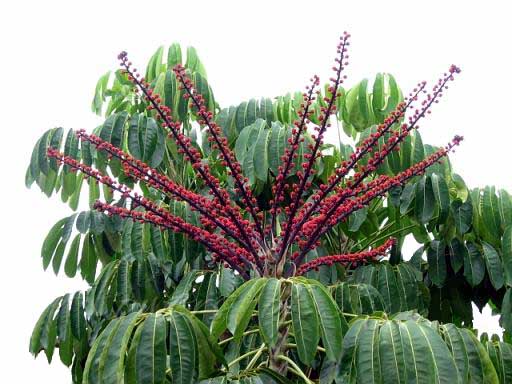
The
Octopus Tree Schefflera actinophylla is an evergreen tree growing to
15 m
tall. It has compound medium green leaves in groups of seven leaves. It
is
usually multi-trunked, and the masses of bright red flowers develop at
the top
of the tree. It often grows as an epiphyte on other rainforest trees or
as a
lithophyte on rocky outcrops. The Octopus Tree produces up to 1000
individual
flowers generating large amounts of nectar which attracts nectar-eating
birds
and insects. The thousands of fruits produced each containing many
seeds are
eaten by many birds in particular by Black Collard Barbets and by
monkeys, seed
dispersal is
predominantly carried out by birds.
Octopus
tree is a most fitting name for this highly invasive and very
destructive tree
which with its octopus like roots is even able to grow on boulders, the
octopus
like roots are very invasive and destructive damaging, house
foundations,
buildings and blocking drains. Here in Durban one can very often see
the
Octopus tree growing as an epiphyte in particular high up on the roofs
of
buildings where it causes considerable structural damage to the
building if not
removed right away. It is a very aggressive plant and its roots
dominate the
surrounding soil. In many tropical and subtropical areas around the
world it
has become a very invasive and destructive weed, because of its rapid
growth,
its habit of forming dense stands, and its epiphytic nature make the
octopus
tree potentially detrimental not only to native plant communities but
to
buildings and other man made structures as well. The Octopus tree can
cause
contact dermatitis in sensitive individuals.
Control
The
Octopus tree is very difficult to control once established on a large
scale. Control
of newly established, small, and young populations is probably easier
than the
control of well established, mature populations. The eradication of
octopus
trees with stem diameters greater than 25 cm is extremely difficult.
Physical
or mechanical control: Hand pulling of seedlings and young
saplings is recommended. Cutting down of larger trees requires a
follow-up treatment with a chemical herbicide to control re-growth and
sprouts from the remaining roots. Freshly cut stumps must be treated as
soon after cutting as possible preferably within 2 hours.
Chemical
control: The Octopus tree is very difficult to control with
herbicides in
addition the effects of herbicides may not be seen for months, and
follow-up
treatments will be necessary. When the octopus tree is growing as an
epiphyte,
herbicide applications require care to avoid harming the host plant.
Those with
experience controlling the octopus tree recommend cutting trees and
treating
the stumps with a herbicide.
Herbicides
containing the following active ingredients and at the dose rates
suggested
below have shown a measure of success.
| Method |
Active
ingredient |
Dose
rate |
| Cut
stump, or paint basal green bark |
Glyphosate(360
g/L) (Roundup)
|
85
ml per 1L water |
| Drill,
frill, axe or stem injection |
Glyphosate
(360 g/L) (Roundup)
|
500 ml per 1L water
Apply 1
ml per 2 cm cut |
| Basal
bark application |
Triclopyr (240 g/L)(Garlon)
Picloram (120 g/L) (Tordon) mixed in equal proportions
|
100 ml
of mix per 6L diesel |
Conclusion:
The
Octopus tree has become a very serious pest plant in many other
countries with
climates similar to our climate here in Durban. Looking at the rapid
increase
of these plants in only a few years it is certain that these trees very
will
soon present the same problems here in the Durban area, therefore it is
the environmental
and social responsibility of every landowner who has an Octopus tree
growing on
his or her property to remove it as soon as is possible and to
encourage others
to do likewise. This tree urgently needs to be listed as a category 1
weed in
South Africa in this time of rapid climate change we can not afford to
wait for
the government to make this to happen we must act now to eradicate the
Octopus
tree before it is too late for it to be controlled.
Michael
Hickman 24.03.12
Download
the article as a word document